PART ONE — THE NEW FRONT DOOR
Chapter 4 — The Room You Have to Be In
The comfortable story says domain authority no longer matters and a small specialist can leapfrog an incumbent on structure alone. This chapter tests that against the evidence on how many cited domains already rank, introduces the five levers — entity, reachability, corroboration, specificity, usability — and names which lever each later chapter delivers.
From Becoming the Answer by Jeremy Osborn · 687 words
There is a comfortable story about AI search that goes like this: the old rules are dead, domain authority no longer matters, and a small specialist with well-structured content can leapfrog an incumbent by writing the right passages.
Parts of that are true. The whole of it is not, and the difference is worth a great deal of money.
What the strongest evidence says
Start with the Washington University audit of real AI Overviews. Of the domains cited in those answers, 29.8 percent did not appear anywhere on the accompanying first page of results.
Which means roughly seventy percent did.
Kevin Indig’s analysis of about 1.2 million ChatGPT responses found the same relationship from another angle: pages ranking first in Google had a 43 percent citation rate, three and a half times the rate of pages ranking beyond position twenty.
And when researchers built a benchmark specifically to test whether AI-era content tactics work — presented at NeurIPS in 2025 — they found that most of them were ineffective or actively harmful to ranking, and that traditional search optimization was significantly more effective.
The largest controlled experiment in the field, 252,000 trials across six models, tested eighteen content factors one at a time. The factors that dominated were topic relevance, the presence of price information, recent timestamps, and position in the candidate list. Formatting and content structure showed minimal effect.
The uncomfortable conclusion
Getting into the retrieval set dominates everything that happens afterward.
If you are not findable, not indexed, not ranking, not known — no amount of passage engineering rescues you. The clever stuff operates on the candidates that made it into the room. It does not get you into the room.
This is less exciting than most of what is sold under this heading. It is what the data supports.
It also has an immediate budget implication. An AI visibility program that neglects the fundamentals of being findable is optimizing the second half of a race it hasn’t entered. If your organic search foundation is weak, fixing that is your AI visibility strategy for the next two quarters, and anyone selling you something else is selling you something else.
What genuinely is new
So is any of this new? Yes. Four things, and they’re the four this book spends its middle on.
The entity layer. A machine cannot apply a credibility judgment to something it can’t identify. And because most questions never trigger a search, what the model already believes about your company is the whole game for the majority of queries. That’s a brand and communications problem, not a publishing one, and almost nobody owns it.
The corroboration layer. Grounding confidence counts how many independent documents verify a claim. Independent agreement isn’t reputation management in the soft sense — it’s an input to a score. The correlational data agrees: unlinked brand mentions track AI visibility far more strongly than backlinks do.
The specificity layer. Query fan-out means the competition happens on attribute intersections that never appear in a keyword tool. Winning “best payroll software” is worth less than winning “payroll for a dental practice with tipped employees.”
The agent layer. A brand an assistant can’t read, price, or transact with is a brand it routes around. This is mostly unglamorous data work, and it’s specified in public documentation, which makes it the most certain investment in the book.
The five levers
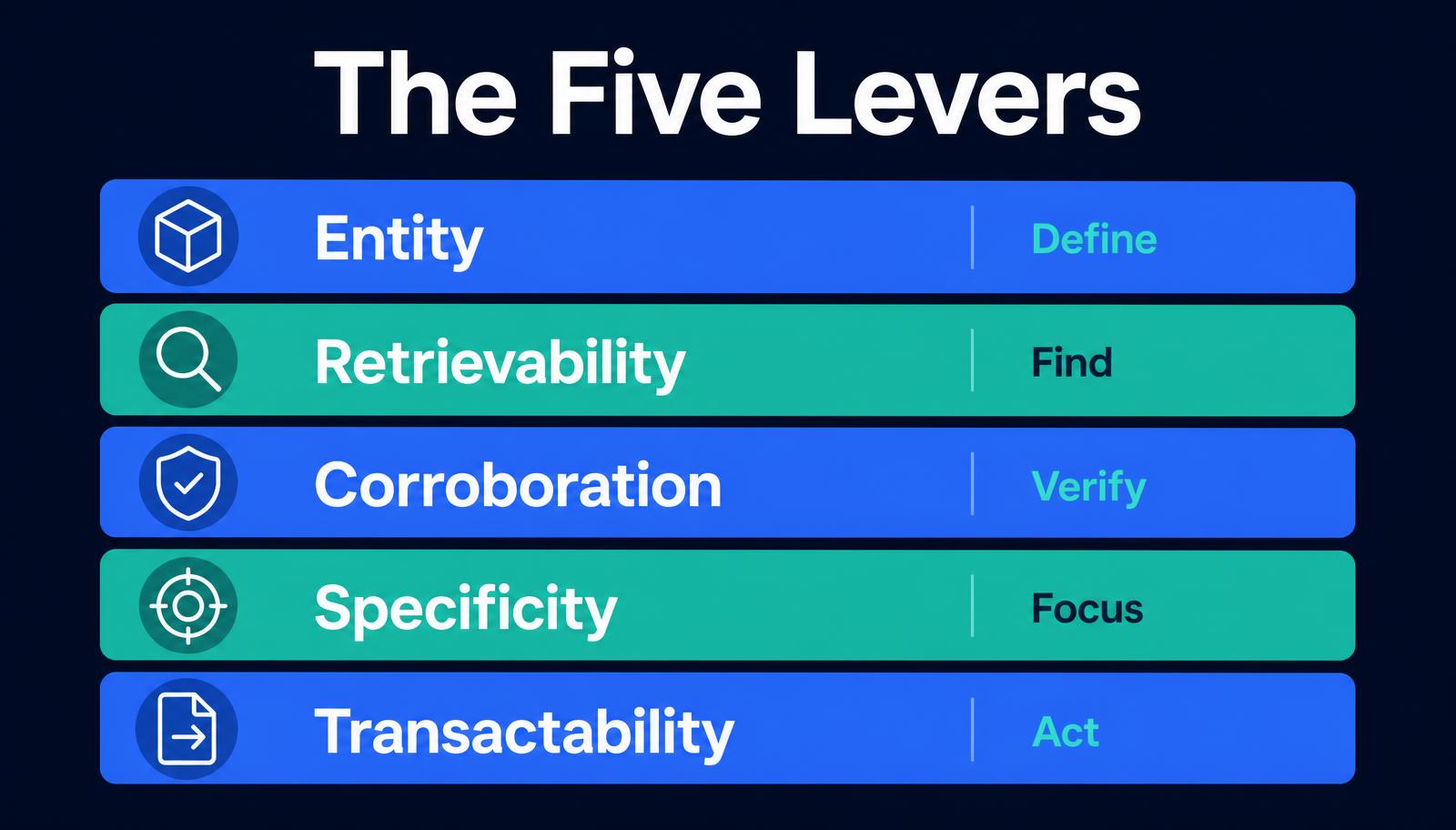
Which gives us the structure for what follows. Five levers, in dependency order, because they build on each other.
| Lever | The question | Who owns it |
|---|---|---|
| Entity | Can the machine name you? | Brand and communications |
| Reachability | Can it read what you published? | Engineering |
| Corroboration | Does anyone independent agree? | PR and community |
| Specificity | Do you answer the exact question? | Content, briefed by sales |
| Usability | Can an agent act on your behalf? | Ecommerce and product |
Notice the right-hand column. Only two of the five sit where AI visibility usually gets assigned, which is a large part of why it usually stalls.
Entity comes first because nothing else works if the system can’t tell who you are. Usability comes last because it only matters once you’re being recommended.
Let’s start at the beginning.