Measurement
AI Share of Voice: How to Measure Brand Visibility in AI Search
AI share of voice is the definitive benchmark for AI search visibility. Here's how to define your prompt universe, calculate share of voice, and grow it.
Last reviewed: June 22, 2026
AI share of voice is the executive metric of the AI search era. It quantifies how often your brand appears — and how often competitors do — across the prompts your buyers actually run. Done well, it becomes the single number your CMO and board use to judge the AI SEO program.
- AI visibility monitoring
- AI visibility tracking
- LLM visibility tracking
Why share of voice is the right executive metric
Individual prompt wins and citation counts are useful for operators, but they don't scale to a boardroom. Executives want a defensible, category-level number that answers a simple question: are we winning?
Share of voice does that. It aggregates thousands of prompt-level outcomes into a percentage: of every AI answer generated in our category last month, what share cited or recommended us versus each named competitor? Framed that way, the number is intelligible to anyone in the business.
Defining your prompt universe
Share of voice is only meaningful against a weighted prompt universe. A random keyword list — the SEO habit — produces a random number that moves with query mix, not with performance.
Start by segmenting prompts by funnel stage: informational (learning the category), comparative (weighing options), and decision (choosing a vendor). Weight decision-stage prompts most heavily; a competitor overtaking you on 'best [category] tools for [ICP]' matters more than one overtaking you on 'what is [category].'
Size the universe to your category. Broad B2B categories usually need 500–2,000 prompts to produce a stable SOV number; narrower verticals can hold a defensible baseline at 200–400.
Infographic
AI share of voice formula
How we calculate weighted SOV
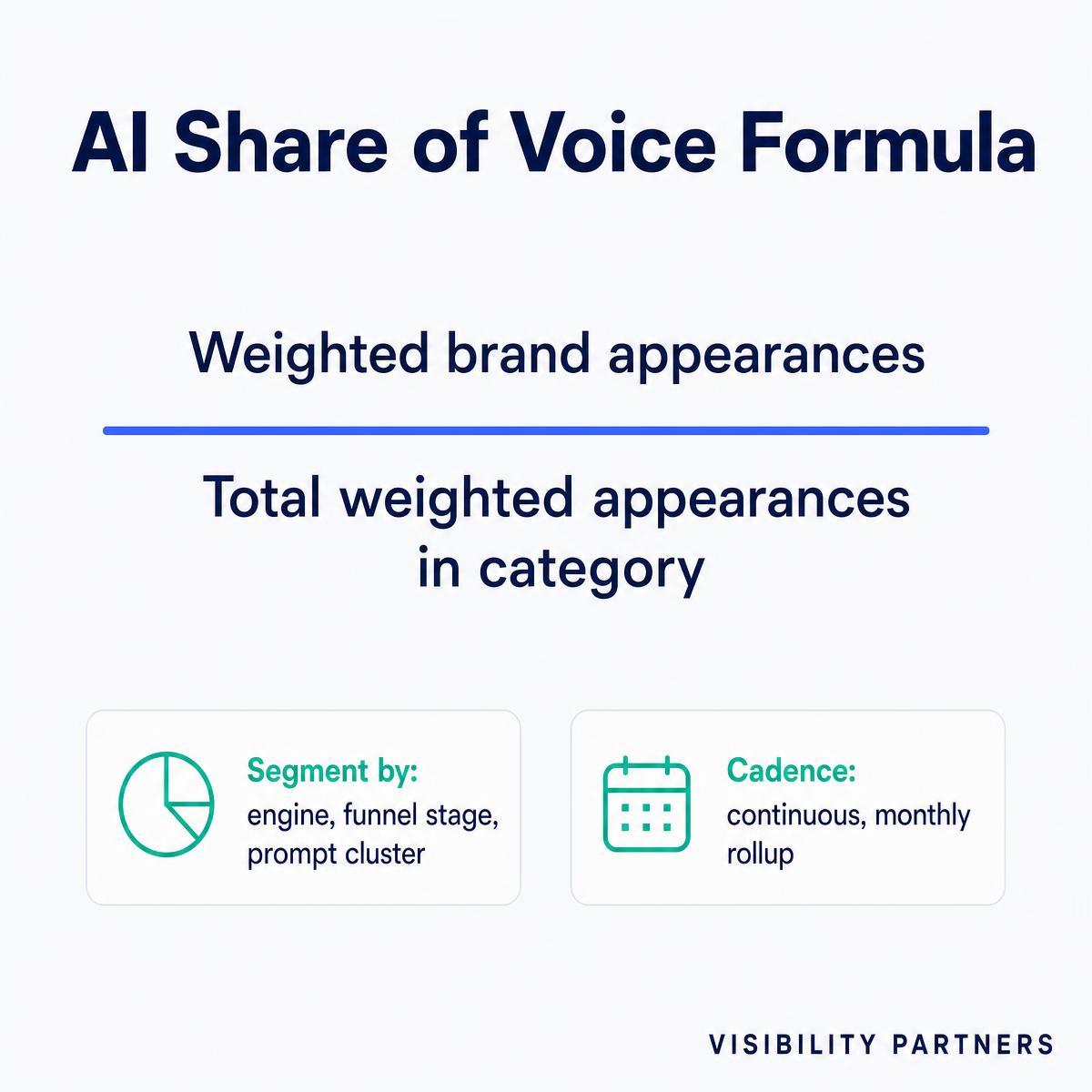
- Numerator
- Weighted brand appearances
- Higher weight for decision-stage prompts
- Denominator
- Total weighted appearances across the category
- Segment by
- Engine, funnel stage, prompt cluster
- Cadence
- Continuous with monthly rollup
How to use AI visibility tracking
- Run the prompt universe on a continuous cadence across ChatGPT, Gemini, Perplexity, Copilot, and AI Overviews
- Alert when a competitor overtakes you on a decision-stage prompt
- Report SOV movement monthly, tied to content, entity, and PR milestones
- Set quarterly SOV targets by prompt cluster
- Break out sentiment separately — being mentioned negatively is not a win
LLM visibility tracking in practice
LLM visibility tracking is the same discipline framed around large language models specifically. In practice a mature program covers all major engines, but reports LLM tracking (ChatGPT, Gemini, Perplexity, Copilot) separately from AI Overviews, because the mechanics and remediation levers differ.
Our AI visibility monitoring service runs the tracking end-to-end: prompt universe design, continuous sampling, alerting, and executive dashboards. Teams that try to build this internally usually stall inside three months — not because the concept is hard, but because keeping the pipeline honest against every engine's rate-limits and behavior drift is a full-time job.
How to grow share of voice
SOV is a compound metric — you grow it by moving the underlying levers: content, entities, and citations. That means an SOV target has to be paired with a program plan. 'Grow SOV 30% next quarter' is a target; 'ship six pillar pages, confirm three entity properties, and land eight citations in the top-15 source domains' is the plan that moves it.
Expect a J-curve. Programs that touch all three levers usually see three flat months before compounding kicks in. Programs that only touch one lever stay flat.
Frequently asked
Keep reading
Ranking is no longer enough
You need to be cited, mentioned, and recommended.
Being cited, mentioned, and recommended are three different outcomes, and most brands only ever achieve the first one. Ranking is no longer enough because AI engines answer buyers directly and name only a short list of vendors as the recommendation — everyone else is cited in passing, if at all. Get a free AI Visibility Report to see exactly where your brand appears today across ChatGPT, Google AI Overviews, Gemini, Perplexity, and Copilot, where competitors are winning the recommendation instead, and what's keeping you from moving up the shortlist.