Comparisons
GEO vs AEO vs SEO: Definitions, Differences, and Where Each Wins
GEO vs AEO vs SEO explained. Definitions, the differences that matter, and where each discipline wins in a modern B2B AI search program.
Last reviewed: July 2, 2026

GEO, AEO, and SEO are complementary — not competing — disciplines. They target different surfaces, respond to different signals, and produce different measurement dashboards. Here's how they differ, and how a real B2B program combines all three.
- GEO vs SEO
- AEO vs SEO
- GEO vs AEO
Infographic
GEO vs AEO vs SEO at a glance
What each discipline actually optimizes
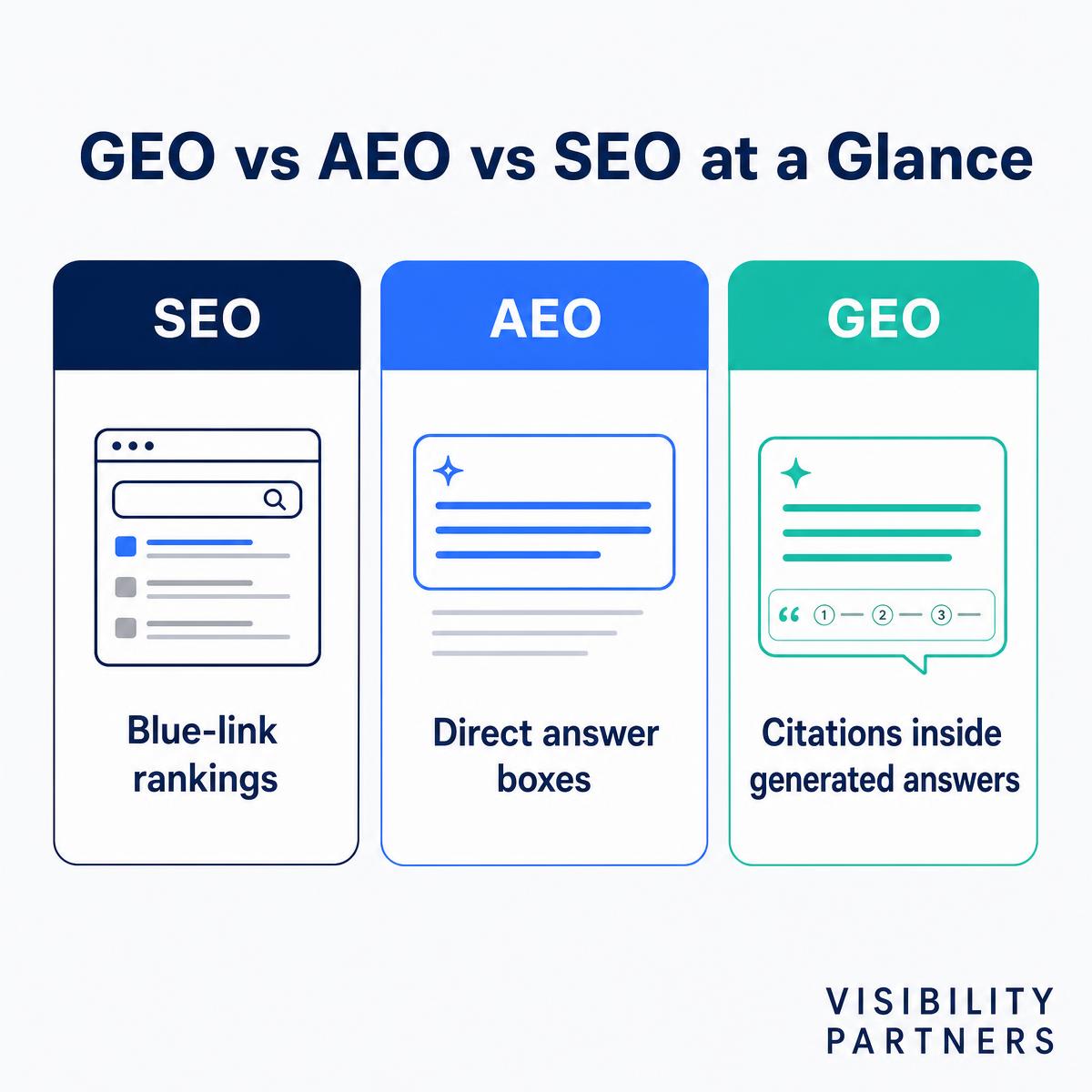
- SEO
- Blue-link rankings
- Google, Bing organic listings
- AEO
- Direct answer boxes
- AI Overviews, snippets, PAA, voice
- GEO
- Citations inside generated answers
- ChatGPT, Gemini, Perplexity, Copilot
GEO vs SEO
SEO wins position in a ranked list. GEO wins inclusion inside a synthesized answer. Both matter — one is about being clickable, the other about being cited — but the mechanics diverge.
SEO rewards link equity, keyword coverage, and content depth interpreted through Google's ranking layers. GEO rewards passage-level extractability, entity confirmation, and citation density on the specific third-party sources each engine trusts.
A page can rank #1 in Google and never be cited by ChatGPT, and vice versa. Most B2B teams discover this the first time they run a real AI visibility audit and see the divergence between their organic dashboard and their citation dashboard.
AEO vs SEO
AEO targets the answer surface at the top of the SERP; SEO targets the ten links below it. When AEO wins, SEO CTR sometimes drops on the same query — because the user has their answer on the SERP.
The net is usually a win. AEO placements carry branding and citation, driving branded search and downstream comparison clicks. They also insulate you against competitors who would otherwise win the answer container above your #1 organic result.
GEO vs AEO
AEO is about structured answers on a SERP. GEO is about conversational answers inside an LLM chat. Both reward extractable content and confirmed entities, but they diverge in emphasis.
AEO leans harder on schema and precise 40–60-word answer blocks. GEO leans harder on entity strength and third-party citation mix. The AEO playbook supports GEO but isn't sufficient on its own — a page that wins snippets can still be invisible inside ChatGPT if the parent brand has no confirmed entity graph.
How to combine them
- Use SEO to maintain baseline organic and technical health — it's still the foundation
- Use AEO to win the top of every SERP where AI Overviews now dominate
- Use GEO to earn citations inside ChatGPT, Gemini, and Perplexity buying conversations
- Report each layer separately — one dashboard cannot represent all three
- Sequence investments: fix technical/entity gaps first, then AEO, then aggressive GEO
The false choice
Vendors sometimes pitch AEO or GEO as a replacement for SEO. That framing exists because it makes a sales pitch cleaner, not because it reflects how the disciplines actually interact.
Healthy technical SEO is a prerequisite for both AEO and GEO — an engine that can't crawl and cluster your pages can't cite them either. And a strong entity graph (a GEO input) also lifts AEO selection. Treat them as a stack, not a choice.
Frequently asked
Keep reading
Ranking is no longer enough
You need to be cited, mentioned, and recommended.
Being cited, mentioned, and recommended are three different outcomes, and most brands only ever achieve the first one. Ranking is no longer enough because AI engines answer buyers directly and name only a short list of vendors as the recommendation — everyone else is cited in passing, if at all. Get a free AI Visibility Report to see exactly where your brand appears today across ChatGPT, Google AI Overviews, Gemini, Perplexity, and Copilot, where competitors are winning the recommendation instead, and what's keeping you from moving up the shortlist.